The Evolution of Corporate Image: Clean Frameworks for Professional Communications

In the modern digital economy, first impressions are no longer made in boardrooms, conference halls, or networking events. They happen in milliseconds inside crowded inboxes.
The Inbox Has Become a Battlefield for Brand Credibility
Every outbound email your company sends is evaluated before a recipient even opens it. Modern enterprise spam filters analyze formatting, embedded assets, external redirects, suspicious links, tracking behavior, and structural inconsistencies long before a human sees your message.
That means your email signature is no longer just a contact block. It is part of your company’s security posture, brand identity, customer relations strategy, and digital professionalism.
Unfortunately, many organizations still rely on outdated signature frameworks overloaded with:
- Oversized banners
- Embedded social media icons
- Tracking pixels
- Base64 image attachments
- Promotional taglines
- Multi-layered redirect links
- Inconsistent typography
What was once considered “corporate branding” now often looks cluttered, outdated, and potentially suspicious. The companies that stand out today are moving in the opposite direction. They are embracing clean, minimal, high-deliverability communication systems.
Why Clean Corporate Communications Matter More Than Ever
Enterprise communication infrastructure has evolved dramatically over the past decade. Email providers now deploy increasingly aggressive filtering systems powered by machine learning and reputation scoring. These systems monitor not only domain authentication protocols like SPF, DKIM, and DMARC, but also visual and structural characteristics within outbound messages.
A bloated signature containing excessive external assets can negatively impact:
- Deliverability rates
- Sender trust scores
- Internal security compliance
- Mobile readability
- Accessibility standards
- Cross-platform rendering consistency
More importantly, cluttered communications create subconscious distrust. Customers, investors, recruiters, and partners associate clean formatting with operational maturity. Minimalism communicates confidence. When a company’s outbound messaging is streamlined, predictable, and visually disciplined, recipients perceive the organization as technically competent and professionally managed.
This becomes especially important in industries where trust and precision matter:
- Technology
- Finance
- Consulting
- Legal services
- SaaS platforms
- Enterprise software
- Digital marketing agencies
In these sectors, presentation quality directly influences perception.
The Rise of Minimalist Brand Architecture
Modern brand management has shifted away from aggressive visual overload. Instead of forcing promotional material into every communication touchpoint, leading organizations are prioritizing consistency, readability, and authority.
This evolution is visible across:
- Corporate websites
- LinkedIn outreach
- Investor communications
- SaaS onboarding systems
- Customer success interactions
- Internal collaboration platforms
- Executive correspondence
The email signature has become part of this broader minimalist ecosystem. A well-designed signature should feel structured, clean, and trustworthy.
Example:
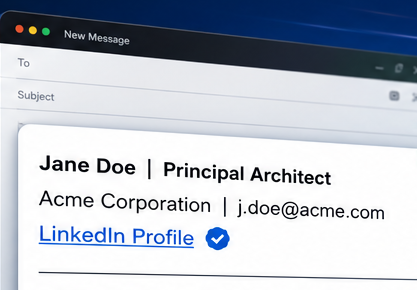
Notice what is absent:
- No oversized logos
- No flashing banners
- No hidden redirects
- No heavy image payloads
- No excessive social icons
- No promotional noise
The result feels intentional and enterprise-grade.
LinkedIn and the Professional Trust Pipeline
LinkedIn has become one of the most important trust-verification platforms in modern business communications. When a clean email signature links directly to a verified LinkedIn profile associated with a real company domain, recipients gain immediate confidence. This matters because professional verification has become part of customer relations strategy.
A strong communication stack now typically includes:
- A properly authenticated enterprise email domain
- A clean signature framework
- A verified LinkedIn presence
- Consistent branding across platforms
- Secure HTTPS infrastructure
Together, these elements create what many digital marketing teams refer to as a “trust pipeline.” Every interaction reinforces legitimacy. Every communication feels aligned. Every platform validates the others.
This consistency becomes particularly powerful during:
- B2B outreach
- Investor communication
- Recruitment campaigns
- Client onboarding
- Enterprise sales negotiations
- Partnership discussions
Professionalism is cumulative. Small signals compound into brand authority.
Constructing a High-Deliverability Email Signature
Designing a modern corporate signature is less about aesthetics alone and more about technical optimization. The objective is simple: Create a signature framework that renders cleanly across clients while minimizing spam-triggering behaviors.
Step 1: Access Advanced Signature Controls
Navigate to your enterprise mail client’s advanced signature settings. Whether your organization uses:
- Microsoft Outlook
- Google Workspace
- Proton Mail
- Zoho Mail
- Apple Mail
- Exchange environments
…the goal remains the same. You want granular control over the HTML structure. Avoid drag-and-drop builders that inject bloated markup or hidden tracking layers.
Step 2: Remove Embedded Image Assets
One of the most common corporate communication mistakes is embedding raw images directly into signatures.This includes:
- Base64-encoded icons
- Embedded logos
- Tracking pixels
- Promotional banners
- External image calls
These assets can:
- Increase spam scores
- Slow rendering performance
- Break formatting on mobile devices
- Trigger security warnings
- Create accessibility issues
Modern enterprise communication favors lightweight text-first structures. If branding is necessary, keep visuals extremely minimal and externally optimized.
Step 3: Use Web-Safe Typography
Typography consistency is critical. Use widely supported fonts such as:
- Arial
- Helvetica
- Verdana
- Georgia
- Tahoma
Avoid decorative or custom-loaded fonts. The goal is rendering consistency across:
- Desktop clients
- Mobile devices
- Webmail interfaces
- Enterprise security gateways
A signature should remain readable regardless of environment.
Step 4: Validate Every Hyperlink
Every outbound link in your signature should:
- Use HTTPS
- Point directly to trusted destinations
- Match your enterprise domain
- Avoid unnecessary redirects
- Exclude suspicious tracking parameters
Example of good practice:
https://companyname.com
https://linkedin.com/in/janedoe
Example of poor practice:
https://tracking-platform.redirectservice.com/xy12ab?campaign=promoModern spam engines aggressively analyze redirect behavior. Multiple redirect layers often signal phishing or marketing automation abuse.
Step 5: Keep the Hierarchy Clean
An effective email signature should prioritize clarity. Recommended hierarchy:
- Full name
- Role/title
- Company name
- Direct contact information
- One professional external link
That is usually enough. If a recipient needs additional information, they can visit your website. Overloading signatures with excessive content reduces readability and weakens visual authority.
Security and Compliance Considerations
Corporate communication frameworks now intersect directly with cybersecurity. Security teams increasingly audit:
- Signature structures
- Link behavior
- External asset loading
- HTML cleanliness
- Third-party integrations
This is because attackers frequently imitate legitimate corporate signatures during phishing campaigns.
Clean and standardized formatting helps employees and customers identify authentic communications. Organizations adopting minimalist signature frameworks also benefit from:
- Easier governance
- Simplified compliance reviews
- Better mobile rendering
- Reduced attack surface
- Lower infrastructure overhead
What once looked like a purely branding-related decision is now partially a security strategy.
Also: The Best Cybersecurity Practices for Small Businesses
The Psychological Impact of Clean Communication
Minimalist communication does more than improve deliverability. It changes perception. Recipients subconsciously associate clean formatting with:
- Competence
- Precision
- Reliability
- Transparency
- Technical maturity
Overdesigned communication often creates the opposite effect.
When every email contains banners, promotional graphics, tracking systems, and multiple call-to-actions, recipients experience cognitive overload. This weakens trust. Clean communication frameworks create focus. They signal that the sender values clarity over noise. That distinction matters in high-level professional interactions.
The Future of Professional Brand Communication
Corporate branding is evolving toward lightweight, secure, and frictionless communication systems. As AI-driven spam detection becomes more sophisticated, organizations that continue using outdated signature practices may experience:
- Reduced deliverability
- Higher spam classification rates
- Lower engagement
- Declining brand trust
- Increased security scrutiny
The future belongs to organizations that understand a critical reality: Professionalism is infrastructural. It is reflected not only in websites and advertisements, but also in the smallest technical details of daily communication. A clean signature framework may seem minor. But across thousands of outbound interactions, it becomes part of your organization’s digital identity. And in a crowded inbox, identity is everything.
Final Thoughts
Modern corporate communication is no longer just about sending messages. It is about engineering trust. The most effective companies are building communication systems that are:
- Minimalist
- Secure
- Consistent
- High-deliverability
- Technically optimized
- Professionally aligned
The humble email signature sits at the center of that transformation. Companies that modernize these small but critical touchpoints position themselves as organized, trustworthy, and operationally mature. In today’s digital ecosystem, those signals matter more than ever.