The Rise of Micro-Communities: How Group Chat Apps Reshaped Social Landscapes

Why This Matters Now
In 2025, the era of open-broadcast social media has reached a critical breaking point. Algorithmic feeds optimized for outrage, relentless commercial tracking, and an influx of AI-generated junk content have turned public timelines into chaotic, uncurated spaces. In response, a massive digital migration is underway. Users are abandoning public town squares in favor of invite-only, end-to-end encrypted micro-networks. This shift is fundamentally changing how digital communities form, how brands communicate, and how individuals safeguard their mental health against screen fatigue.
The Migration from Timelines to Digital Living Rooms
The traditional social media playbook—getting users to broadcast their personal lives to a public audience of strangers—is losing its grip on user engagement. The massive drop in public posting across traditional platforms stems from a simple desire for digital safety. Users are tired of having their opinions stripped of context or indexed by open search platforms. Instead, communication platforms like WhatsApp and Telegram are rapidly taking over, rolling out advanced community layers designed to function as private, segmented micro-networks.
This is a structural shift in network engineering. Meta has invested heavily in rebuilding its core messaging architecture around WhatsApp Communities, allowing users to combine multiple related group chats under a single, administrative umbrella. Think of it as a virtual apartment building: the community is the main building, and individual group chats are the private rooms. This design meets a massive consumer demand for quiet digital spaces. By moving daily interactions into curated rooms, users can control their digital boundaries and stay connected with family, neighborhoods, or professional circles without the constant background noise of global algorithms.
The Architecture of Privacy: Gated Network Layers
What sets the micro-community trend apart from old-school group messages is the deep, structural use of specialized administrative controls and advanced cryptographic protocols. These private channels are built entirely on the principle of gated access, relying on peer-vetted invite tokens rather than open links that can be scraped by automated web crawlers.
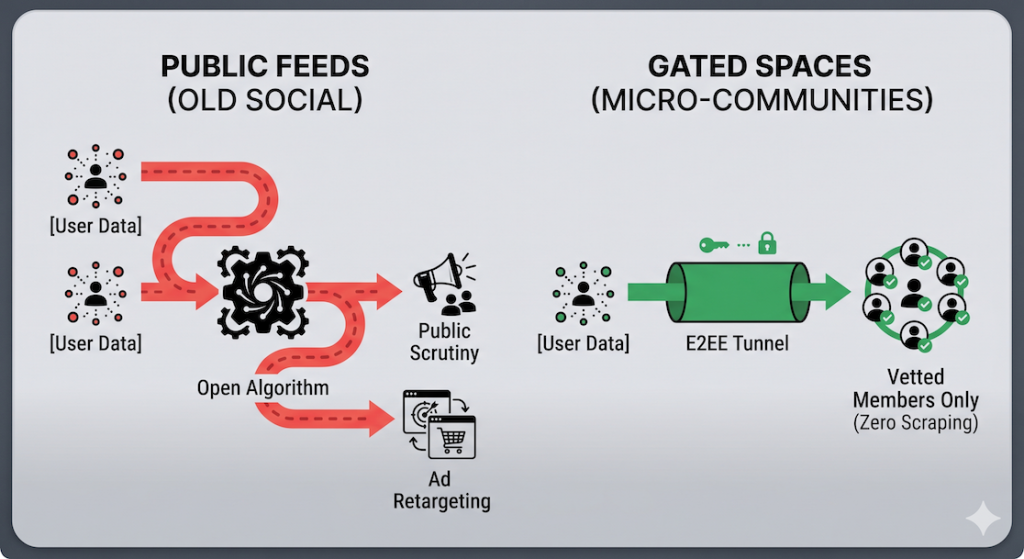
For instance, Telegram’s tiered topic channel systems and WhatsApp’s administrative approval structures allow groups to grow to thousands of members while remaining clean and focused. Administrators can toggle granular permission states—such as disabling raw media downloads, preventing text forwarding, or capping link-sharing to pre-approved corporate domains.
This infrastructure provides a level of data isolation that public timelines cannot match. Because these networks operate entirely within end-to-end encrypted (E2EE) tunnels, personal interactions remain shielded from data brokers and advertising crawlers. This makes these spaces highly attractive for neighborhood associations, professional masterminds, and specialized trading networks.
Step-by-Step: Constructing a Gated Micro-Network
If you want to move your team, family, or core audience off noisy public feeds and build an organized private network, use this deployment structure:
- Isolate Your Root Directory: Open your messaging platform of choice, select the option to initiate a new Community (on WhatsApp) or a Group with Topics (on Telegram), and define a clear, non-public directory identity.
- Segment Your Topical Sub-Channels: Avoid creating a single, chaotic chat room. Build distinct, role-based sub-channels dedicated to specific operational workflows (e.g.,
#Announcementsfor read-only alerts,#Logisticsfor coordination, and#GeneralChatfor casual banter). - Enforce Strict Access Protocols: Turn off open auto-join links. Generate restricted invite links that require explicit administrative approval before a new user profile is granted entry into the system directory.
- Configure Privacy and Download Restrictions: Navigate to the advanced safety controls and toggle off “Save to Gallery” and “Allow Forwarding.” This simple setting keeps shared media and conversations safely inside the boundaries of your group.
- Establish Automated Moderation Benches: Integrate basic automation bots to monitor the chat room. Set up keywords to instantly block incoming spam, commercial links, or unvetted tracking tokens before they cause visual clutter for your users.
Pro-Tip: If you use private groups to manage professional remote work teams or distribute sensitive brand assets, combine your messaging rules with secure device access protocols. Ensure all active community members are routing their traffic through verified network pathways, which works hand-in-hand with tools like a corporate VPN network array to stop security leaks at the network edge.
Verifying the Network Standards
- Secure Enterprise Infrastructures: For a comprehensive look at how secure communication hubs fit into a wider network defense strategy, read up on the W3C Security and Privacy Design Core Specifications governing modern application data separation.